Showing posts with label Morocco. Show all posts

Friday, December 6, 2013

#743 Ceuta & Melilla, Spain


www.marrocos.com
When I lived in Morocco, the two African enclaves belonging to Spain fascinated me. That Spain would continue to claim such a territory in a vestige of colonialism was crazy, especially with repeated calls from Morocco to return them. It is also ironic considering that Spain demands the return of Gibraltar (#877). Despite being strategic port cities, they have little appeal for most Spaniards to the point that the Spanish government had to offer them tax-free status in order for them to get people to live there.

Mellila according to www.paradiseintheworld.com
http://hablemosunpocodetodo.blogspot.com/2010/08/ceuta-y-melilla.html
They were a convenient place for us to be able to renew our Moroccan visas, but an unfortunate flat tire set us back so when we arrived at Mellila in the middle of the night, I felt bad leaving our Moroccan friend alone on the Moroccan side (with the rental car that could not cross), that I never even got there. I went to Ceuta, but my boyfriend didn't want me to leave Morocco, so it prevented me from really luxuriating and enjoying it. I think he was jealous he could not visit without his passport, and I suppose it was selfish of me to want to linger there with them waiting.

I remember Ceuta being a particularly unexciting little Spanish town, with the banks and shops closed because it was Sunday. There was a beautiful mosaic in the bank, however... funny how you remember these things!

Looking at photos of Mellila and Ceuta (known as Sebta in Arabic) I would like to return and see them again with adult eyes.

Source: http://paradiseintheworld.com/melilla/


Friday, November 29, 2013

#746 Old Medina, Rabat, Morocco

The view of the twin city of Sale across the river mouth as viewed from Rabat's old city.
I think if I had to pick a favorite capital city in the world, it might be Rabat, in Morocco. It is small and manageable, but central to the country and all the things one might need such as beaches, culture shows, and heritage. The incredible half completed Hassan Mosque (#864) sits on the top of the river cliff overlooking Sale the equally magnificent old city across the water (the Oued Bou Regreg). But one of the glories of Rabat is the old city which sits majestically on the cliffs above the beach, overlooking all that was important in its trade-packed history where it has risen to importance and fallen into village obscurity. It is not a huge old town, but what it lacks in size it makes up for in pretty alleyways and excellent shopping!
I think one of my favorite memories is from my first visit to the city. I was shopping in the old souq for souvenirs and gifts for Christmas, but it was hot and almost lunchtime, and one by one all the shops closed up for an afternoon siesta. The pretty wooden doors were soon all boarded up and the previously busy street was empty and quiet.
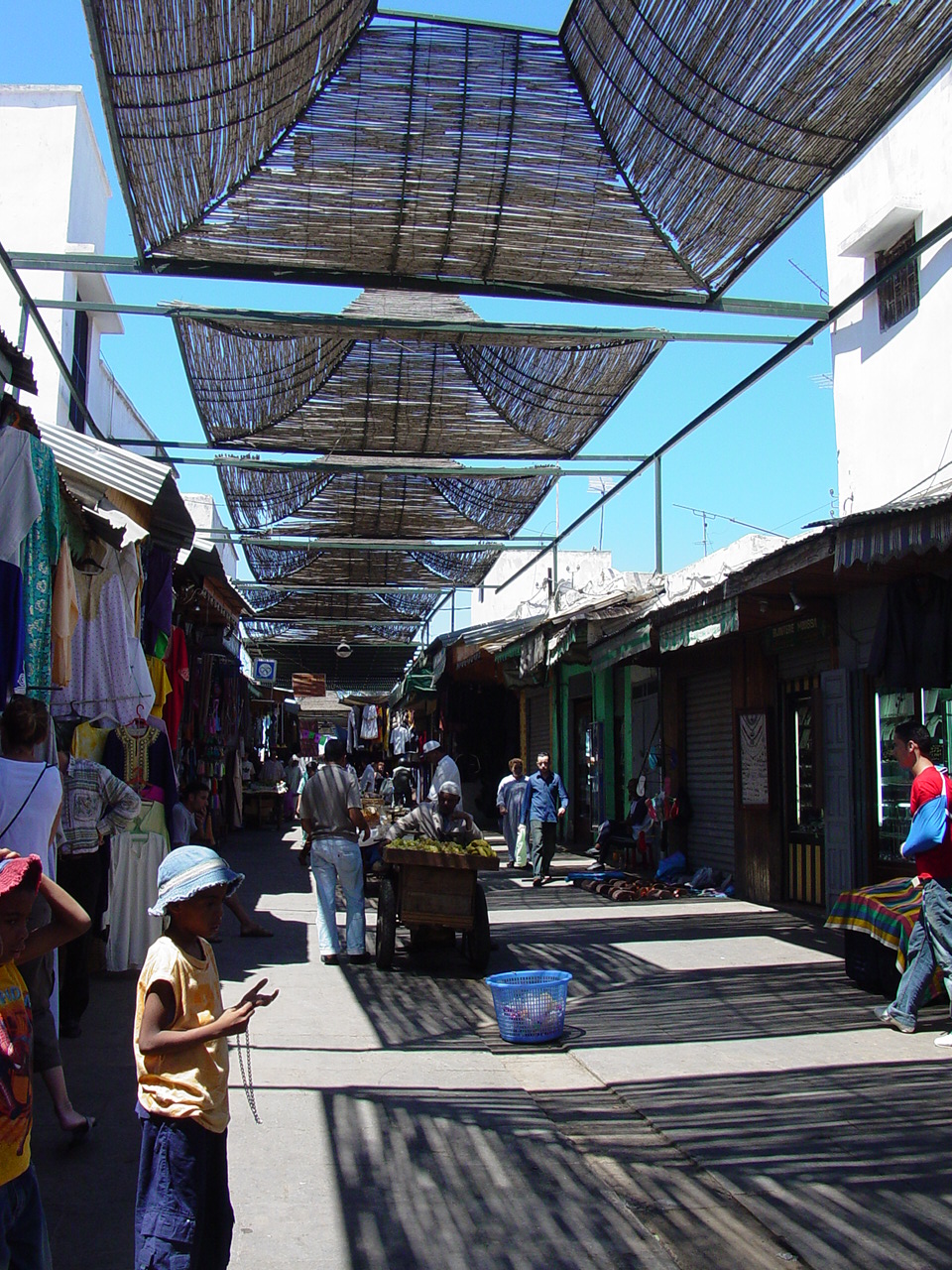
Returning years later when I was visiting Morocco for a friend's wedding, I was impressed that the beautiful sun shades and arches were still there and just as beautiful as I remembered.
The city is painted white and blue and green, but not overly so, and it is kept clean and safe because of both it's small size and the tourists that pass through, but it is local in a way that Fes and Marrakech are touristy.

Rabat has really only been the capital of Morocco since it was part of the French protectorate (away from the intrigues of the traditional capitals of Fes (#929), Meknes, and Marrakech (#988), although there were two brief imperial capital periods. However, it has been settled since the 8th century BC, with the necropolis at Chellah, a Phoenician then Roman settlement (called Sala Colonia), evolving into a Berber kingdom (keeping prominence as a settlement long after the Romans were gone, similar to its more northern cousin Volubilis (#912)). In the 10th century, the Zenata tribe that controlled Sale built a ribat (fortress-monastery) on the site of the Kasbah, which was later rebuilt by the Almohads in the 12th century. After the successful campaigns against the Spanish Reconquista under Yacoub al-Mansour, Ribat al Fatah (Victory Fortress) was expected to become a great capital, and the extensive walls and Bab Oudaia gate were built, the grand mosque planned, but all came to a halt with Al-Mansour's death in 1199 and the town fell from significance.
In the 17th century there was an injection of new settlers in the area with refugees from Muslim Spain, Christian renegades, Moorish pirates, corsairs and other adventurers, many of whom roamed the Atlantic for Christian slave labor, only partially reined in by the Alawite sultans. The old city has survived from this era, and the modern capital (since 1956 independence) was a recognition of its suitable location, but the old part of the city is definitely smaller than those in Fes, Meknes and Marrakech.
Inside you will find the Souq as-Sebbat with lots of jewelry for sale, and a small flea market near the river. In the days of the Sallee Rovers, the broad open area near the Kasbah was site of the slave auctions.


Source: Lonely Planet Morocco 6th Edition 2003

Sunday, April 7, 2013

#847 Hassan II Mosque, Casablanca, Morocco

The first modern mosque I ever visited in the world was this impressive one, with the waves of the Atlantic Ocean lapping underneath, in Casablanca, Morocco. It was my first real exposure to the modern interpretations of Islamic Architecture, which would become a passion, and a wonderful experience of the tranquility and peace inside mosques.
With doors large enough for the king to ride his horse through, the mosque is not intended to replicate older mosques that Morocco is also famous for, such as Le Tour Hassan in Rabat (#864), or the Kotoubia Mosque in Marrakech (#988), but to show Morocco's modern strength and piety, although many Moroccans do not consider the Hassan II mosque as sacred because infidels are allowed inside.
Next to the old medina in a spectacular location, it was at one time the world's 3rd largest religious monument with the world's highest minaret (210m). Finished in 1993 for the late king's 60th birthday, it required 10,000 craftsmen 5 years to finish. It was designed by a French architect, Michel Pinseau, and had the latest technology such as headed floors, electric doors and a sliding roof, although its traditional zellij mosaic tiles were painstakingly put in place one by one, an exemplar of Morocco's strong traditional artistry. Its cedar interior comes from the Middle Atlas mountains, its marble from Agadir, and its granite from Tafraoute, showcasing a strong Moroccan pride.
Source: Lonely Planet Morocco 6th Edition

Friday, March 8, 2013

#860 Mzora Stone Circle, Morocco

Big stellae
Stones lying in the grass

When I was a student in Morocco, one of the things I wanted to see the most was the "Cromlech de Mzora", an ancient stone circle that was barely mentioned in the guidebooks, and unheard of by most Moroccans, so I undertook to do a research paper about it for my class there. The only information I found was in French texts (the names of which I also no longer have), and by renting a car to search it out in its tiny village. Unfortunately, the paper has been lost to the relics of no-internet backups, but I still have the photos I took, and the story of how it was to get there. I apologize to the people that quoted it in their academic papers and thank them enormously for the honor they did to quote me at all -- I will try and locate the paper one day and re-type it!

Whole mound and circle

Biggest standing stone - El Uted "The Pointer"
Bricks under the mound
About half way between the small towns of Larache and Asilah, north of the Roman center called Lixus, the Arab village of Souq Tnine de Sidi el-Yamani is the closest place to the ruins. There are modern buildings and homes scattered right next to the ruins, and the stones themselves are in a bad state of disrepair. A small pond has formed inside the mound that was excavated by French scholars.
Edge of circle

Bilingual Stellae - image from a French text --
this is in a Museum and no longer at the site.
View from the top
Stones outside of circle
Side view of circle
Hunks out of stone - from afar
While scattered, fallen and moved, the presence of 167 intact stones from the circle makes this impressive, as does the fact that you are free to wander freely among them. The state that the French Archaeologists left the site in is quite appalling, but its obscurity in Moroccan history books means that most Moroccans are uninterested in visiting it, so it does not see the same number of visitors that such a site would see in Europe, especially considering its size, and thus it is more preserved than it could be.
Entranceway
Hunks out of stone - closeup view
Copied diagram of Mzora from French text -- cited
French text - inside tomb
mzoura01.jpgmzora-ge.jpgThese two aerial photos were matched on the following google earth blog: http://www.gearthblog.com/blog/archives/2011/01/hunting_for_the_megalithic_stone_ci.html 
One French text I looked at shared this photo, but the surrounding area does not fit reality. The other photo below is more likely, however.

French textbook aerial photo
Tombs south of Morocco
North African monolithic sites
Source: Lonely Planet Morocco, 6th Edition
Here's what the Lonely Planet says, and this was basically all I had to go on when I started my search:
   "The ancient and little-understood Monoliths de M'Soura stand on a desolate patch of ground some 25km (by road) southeast of Asilah. The stones, arranged in a circle, range from 50cm to 6m in height and some historians believe the surround the tomb of a noble, perhaps dating back to Punic times. To get to the site  you must first reach the village of Souq Tnine de Sidi el-Yamani, off highway P37, which branches east off the main Tangier to Rabat road. From here, 6km of bad piste (unsealed track) leads north to the site. You need a good vehicle, and a local guide would help."