Showing posts with label Zoroastrianism. Show all posts

Wednesday, June 5, 2013

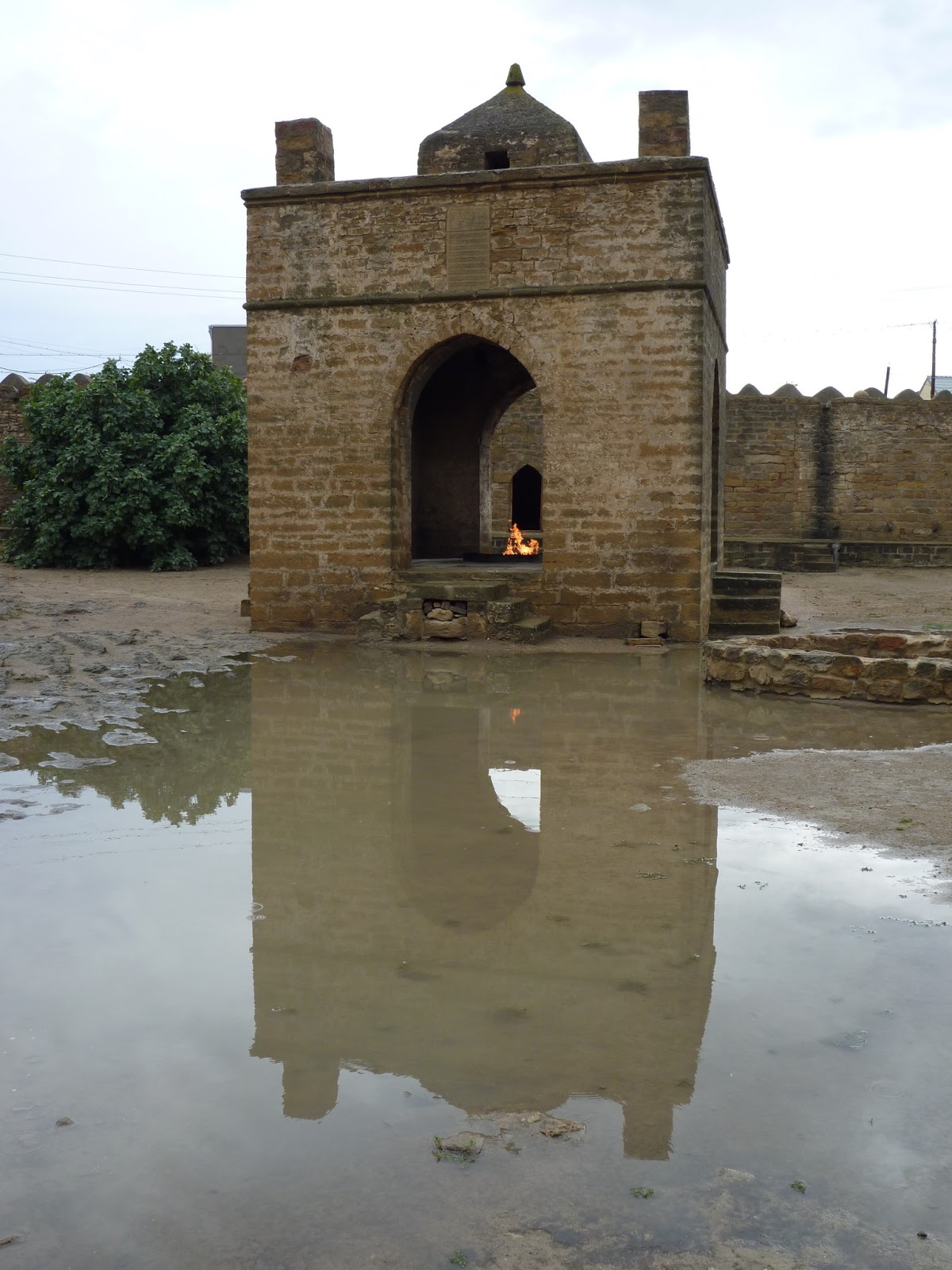
#822 Ateshgah Fire Temple, Abseron Peninsula, Azerbaijan

In the unappealing town of Suraxani, about an hour's drive from Baku is an astonishing fire temple, yet another example of Azerbaijan's rich geothermal connections. 

The structure is not the most intricate religious monument, but a central plaza is surrounded by a cloister of pilgrim cells. The main fire comes from a small shrine in the middle of the courtyard.

The gas pocket below the shrine has become exhausted (sold by the last Hindu priest to the Baku Oil company in 1879) and so gas is piped in -- as needed. When it's lit, flames shoot from the four corners of the central hearth roof. Unfortunately, it isn't lit often, and this kind of situation has been reported as common by travelers dating all the way back to 1881.


There isn't much material on its history - some claim it was 6th or 7th Century Zoroastrians (who came from this region), while others say it was not a temple until 13th C. Ironically, the present is not Zoroastrian at all. Its present structure built by Indian merchants in the early 18th Century and it was used by Punjabi mystics (probably devotees of Jawala-ji, flame-faced incarnation of Devi) this this temple was probably a sub temple to those in Himachal Pradesh's Kangra Valley.
Infamous Caucasus writer Essad Bey (1905-47) "reports that it was briefly the centre of a weird pantheist religion in which reverence to mother earth was symbolized by kissing the breasts of naked female devotees" although his historical authenticity isn't really relied on!

The temple was visited by those as famous as Alexandre Dumas, and it remains a popular tourist site for visitors to Azerbaijan.
Source: Mark Elliot's Azerbaijan 4th Edition p 154-155

Monday, April 1, 2013

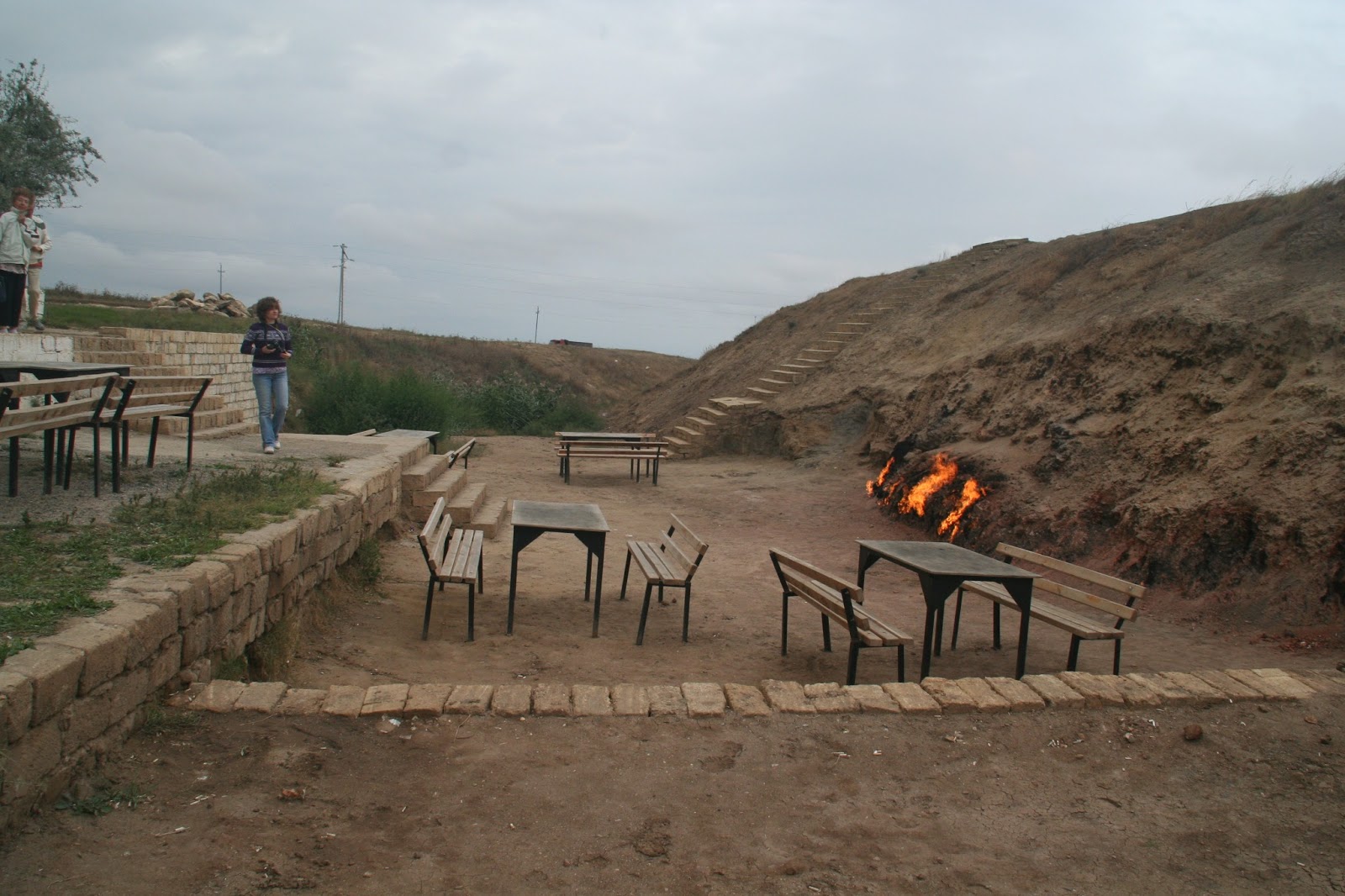
#850 Yanar Dag (Fire Mountain), Abseron Peninsula, Azerbaijan


This mountain is on fire! 


On the edge of a desolate moorland on a small rural road just past the pink salt lake beyond the ugly oil-field turnoff, Yanar Dag (literally Fire Mountain) burns day and night due to the underground gas that was accidentally ignited in 1958. 

A decrepit tea house is at the top of a hill, and in the gully is this amazing piece of nature. It's quite nice to sit beside the flames on a cool winter evening.
Is it natural? Well, it once was, but rumor has it that the Azeri government now pipes the gas in. However, there are other places in the area where natural gas seeps out and can be lit, including some springs and water flows. Zoroastrians worshipped fire and built a temple nearby which can still be visited. 
Mark Elliot's Azerbaijan

Wednesday, August 29, 2012

#942 Aden, Yemen

Very few people know that during the Cold War, it wasn't just Korea, Vietnam and Germany were split in half. Another country that fell victim to the power plays of the powers was Yemen. The capital of South Yemen was the city of Aden, an ancient shipping city, with connections to Africa, the Middle East and the Indies because of its strategic location on the Gulf of Aden (across from the Horn of Africa in Somalia). Infamous today for the bombing of the USS Cole in 1992 which occurred in its harbor and was the start of awareness of Yemen's long terrorism connection which continues to this day. Aden, however is a much more interesting city than just that. 

It was a British port in the Colonial era (a convenient stopping off point en route to India), and one particularly interesting hapstance was when a group of Indian-origin migrant workers built a fascinating Zoroastrian temple on the top of the hill above the city. Zoroastrian temples are used to place the bodies of the dead with the intention that the vultures will pick the bones clean so that they can be collected and stored. The temple is no longer functioning as a temple today in conservative Islamic Yemen, but remains a fascinating relic of a bygone era. 

Another really fantastic historical feature of the city are its series of water cisterns that sit at the bottom of the hills that surround the city. These (the Cisterns of Tawila, named for the Wadi Tawila) form the remains of a highly sophisticated water collection system that supplied the city with water from the hills perhaps as far back as 115BC. They were rediscovered and reused in the 19th Century and can still be used today if needed, although water has not filled them for 15 or so years and they are threatened with development and erosion.

In addition to these features, it is a beautiful city, with cream houses creeping up the brown hills, overlooking the clear blue Indian Ocean. It remains a busy shipping lane despite being one of the poorest and forgotten corners of the world.