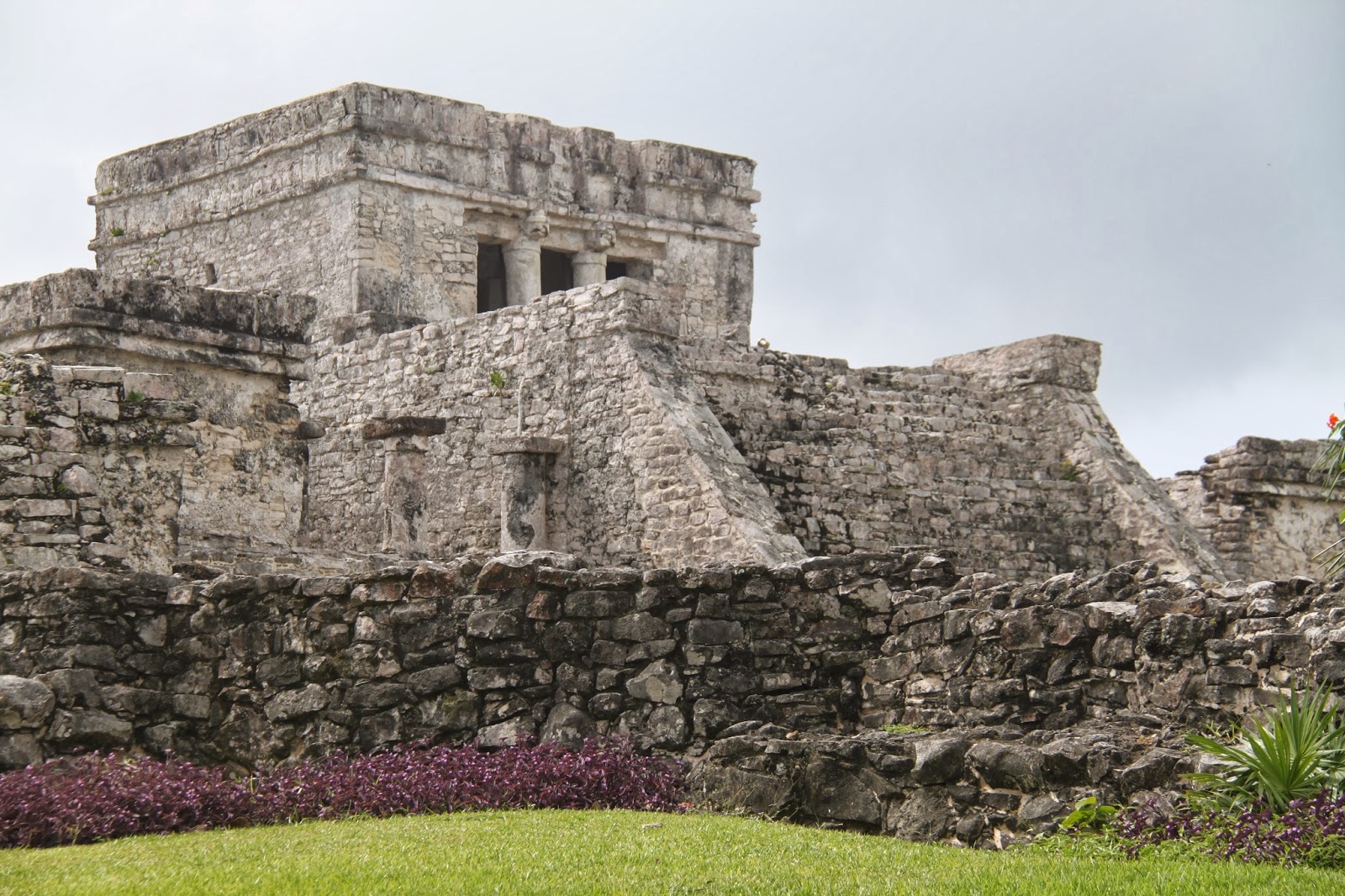
In the heart of the Yucatan Peninsula likes Mexico's crowning historical glory of Mayan traditions: Chichen Itza. With one of the largest, most beautiful pyramids (El Castillo or the Temple of Kukulkan) that at equinoxes reflects a twisting serpent in its shadows, it is rare to see it without a swarm of tourists from nearby Cancun. Typical of most Mayan buildings it was a structure built over top of an older building, with that built on top of something else.

Near to the main square is the great ball court, one of thirteen such structures on the site, but an impressive structure in its own right, flanked by the Temple of the Jaguar and the Temple of the Bearded Man. You can see the "goals" in the walls, at a very high level above the ground making you wonder as to the complex rules of such a sport.

The skull carvings on the Skull Platform (Tzompantli) are an appropriate reminder of the frequent human sacrifices that took place during the Mayan era, evidence of which can be found at the bottom of the 60m wide Cenote Sagrada, where along with gems, pottery, wood and cloth were the skeletons of men and children.
Beautifully decorated buildings, the impressive complex known as the Group of a Thousand Columns, and the El Caracol Observatory all provide testament to the Mayans engineering, learning, arts and culture. I think I love the connection to the jaguar the most!
Source: http://en.wikipedia.org/wiki/Chichen_itza
 Most people in this part of Guatemala are here to visit the famous Tikal (#954), but it would be tragic to pass by Flores without a stop. Where else in the world is there a highly developed colonial island town in the middle of a lake? Lago Petén Itzá is in El Petén Province in North Eastern Guatemala, and Flores is separated from the twin towns of Santa Elena and San Benito by a causeway. The village just north across the lake is San Miguel.
 In Pre-Columbian times, Flores was the Maya city of Nojpetén. The Itza left the Yucatán region in the 13th century and built the city later known as Tayasal as their capital. They called it Noh Petén, literally "City Island". It was also called Tah Itzá, or Place of the Itzá. It was on this island that the last Maya held out as an independent Maya state against the Spanish conquerors despite Hernan Cortes visiting the island in 1541. It was not conquered until 1697, when they attacked via boats. Many Itzá people fled and hid in the jungle for years.