Tuesday, April 9, 2013

#846 Isla Gorgona, Colombia

 
34km off Colombia's wild and mangroved Pacific coast lies the mysterious island of Gorgona, so named for the hundreds of snakes present when Pizarro's ship stopped there in 1524. For a long time a prison and forbidden to outsiders, it is now a majestic holiday resort of wild jungle trails, pristine beaches, spectacular diving, and peace and quiet (one small resort and the boats only cross from Guapi, the nearest village and airport, two times a week).
Nature rules here, as is evidenced by the jungle completely reclaiming the prison over the past 30 years, but also by the hundreds of small monkeys, lizards, snakes, birds, and other creatures. My favorite, by far, were the humpback whales that traverse this coast several months of the year with their babies on their way to and from the tropics and Antarctica. Breaking just off the island, breaching and playing or just breathing, they astonish and excite all visitors when they are seen several times a day. 
Read more here
Source: http://es.wikipedia.org/wiki/Isla_Gorgona

Sunday, April 7, 2013

#847 Hassan II Mosque, Casablanca, Morocco

The first modern mosque I ever visited in the world was this impressive one, with the waves of the Atlantic Ocean lapping underneath, in Casablanca, Morocco. It was my first real exposure to the modern interpretations of Islamic Architecture, which would become a passion, and a wonderful experience of the tranquility and peace inside mosques.
With doors large enough for the king to ride his horse through, the mosque is not intended to replicate older mosques that Morocco is also famous for, such as Le Tour Hassan in Rabat (#864), or the Kotoubia Mosque in Marrakech (#988), but to show Morocco's modern strength and piety, although many Moroccans do not consider the Hassan II mosque as sacred because infidels are allowed inside.
Next to the old medina in a spectacular location, it was at one time the world's 3rd largest religious monument with the world's highest minaret (210m). Finished in 1993 for the late king's 60th birthday, it required 10,000 craftsmen 5 years to finish. It was designed by a French architect, Michel Pinseau, and had the latest technology such as headed floors, electric doors and a sliding roof, although its traditional zellij mosaic tiles were painstakingly put in place one by one, an exemplar of Morocco's strong traditional artistry. Its cedar interior comes from the Middle Atlas mountains, its marble from Agadir, and its granite from Tafraoute, showcasing a strong Moroccan pride.
Source: Lonely Planet Morocco 6th Edition

Friday, April 5, 2013

#848 Krasnaya Ploshchad, Red Square, Moscow, Russia

The most iconic place in Russia symbolizing all that was hated about the Tsars, all that was controlling about the Communists and all that is powerful about Putin and modern Russia: Red Square. With St. Basil's fairy-tale church at the bottom end by the Moskva River, the Kremlin palace and government halls to the right side, the Gum department store on the left side and the imposing gates leading in, it would be an impressive place, but all of that does not encompass its enormous size. 
As you can probably tell from these photos, Red Square is large and imposing -- used in films about the USSR and Russia, paintings and art, and it is symbolic, iconic and memorable. I especially remember the line to see Lenin's embalmed body snakes down one whole side, although we didn't join it! The name Red comes neither from the red bricks nor from red communism, but from krasnaya, which can mean red or beautiful, an improvement from Pozhar 'burnt-out place' which is what it was until the 17th century.
Photos from 1997.

Wednesday, April 3, 2013

#849 Nazca Lines, Peru

It's very common to say that photos don't do a place justice, but in this case, they really don't. The Nazca lines are one of the most incredible things I've seen, and they can only been seen from the air, but the photos just don't capture the magic. 
Human or alien?
The circa 400AD geogyphs cannot be seen well from the ground, though there is a spot off the Pan-American highway where there is a viewing platform and they can be seen from the surrounding hills. This means that tourist flights zip around the 80km plateau area -- that's the only way to really see them. There is an alien-like man, several birds and insects, a monkey, a spider, a dog, hands, along with zoomorphic geometric designs and other images. They must be several hundred meters in size, and are made by clearing the rock-strewn area so that a clear patch is formed -- the sheer size is impressive, but also the mysteries about how and why they were made. 
The Nazca people were responsible for the ceremonial city of Cahuachi, and also created an impressive aqueduct system in addition to these lines. Despite a severe 1996 earthquake that flattened the modern town of Nazca, and floods in 2007 the dry, windless desert helps to preserve these creations. The difficulty of seeing them also helped preserve them for us to see. They were only "rediscovered" relatively recently, when Peruvian archaeologist Toribio Mejia Xesspe saw them from the surrounding hills in 1927, and new figures are still being discerned from the multitude of lines even now. 
However, whether they were to form pictures for gods in the sky, an observatory, a collection of constellations or negative space in the milky way, or a pathway to places of religious observance, they are truly remarkable!
Monkey
Bird
Spider
Map of Nazca sites
Viewing platform on the ground -- very hard to see anything at all!
Source: http://en.wikipedia.org/wiki/Nazca
http://en.wikipedia.org/wiki/Nazca_lines

Monday, April 1, 2013

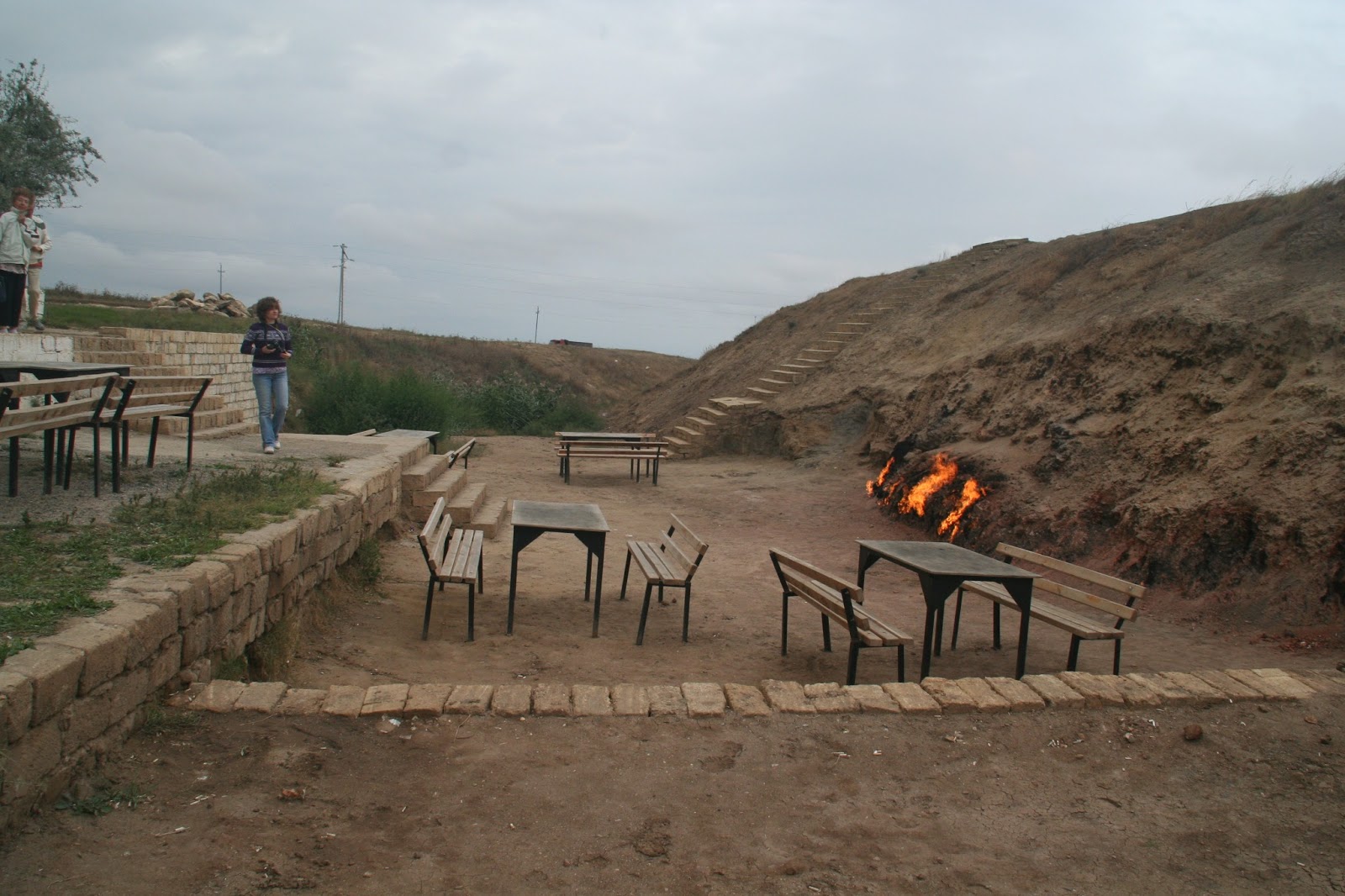
#850 Yanar Dag (Fire Mountain), Abseron Peninsula, Azerbaijan


This mountain is on fire! 


On the edge of a desolate moorland on a small rural road just past the pink salt lake beyond the ugly oil-field turnoff, Yanar Dag (literally Fire Mountain) burns day and night due to the underground gas that was accidentally ignited in 1958. 

A decrepit tea house is at the top of a hill, and in the gully is this amazing piece of nature. It's quite nice to sit beside the flames on a cool winter evening.
Is it natural? Well, it once was, but rumor has it that the Azeri government now pipes the gas in. However, there are other places in the area where natural gas seeps out and can be lit, including some springs and water flows. Zoroastrians worshipped fire and built a temple nearby which can still be visited. 
Mark Elliot's Azerbaijan