Monday, October 7, 2013

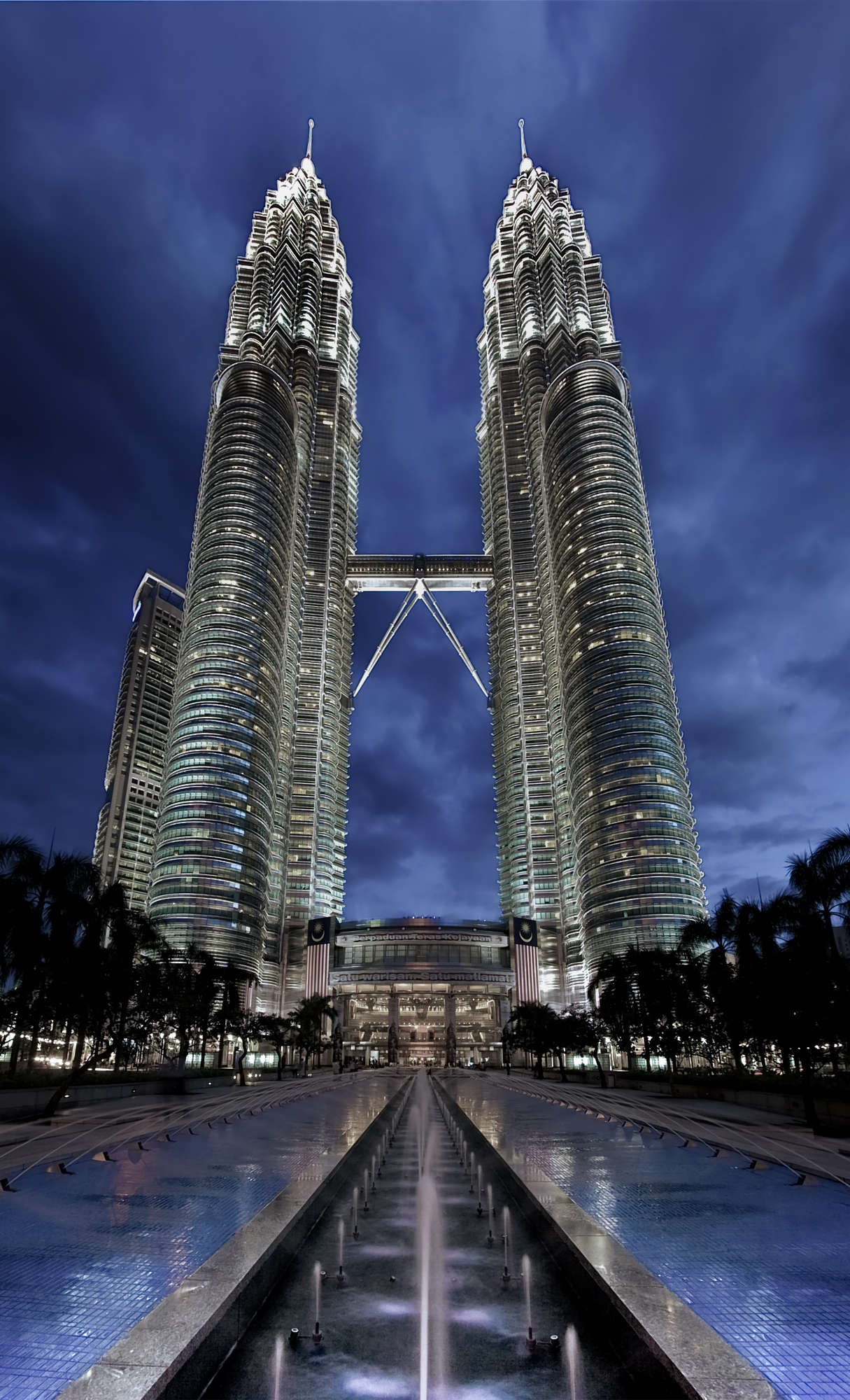
#769 Petronas Towers, Kuala Lumpur, Malaysia

File:Petronas Panorama II.jpg
http://en.wikipedia.org/wiki/File:Petronas_Panorama_II.jpg
I think it was when I saw the movie Entrapment with Sean Connery and Catherine Zeta Jones that I had my first glimpse of what was then (1998-2004) the tallest building in the world, and I was impressed not only for the 'twins' being tall, but also with how beautiful they were, an experience that is matched with Dubai's Burj Khalifa (#909).

Planned from 1992, designed by Argentine architect Cesar Pelli in a post modern style, digging began in 1993 with a 30m depth into the ground and actual construction began in 1994. They are easily viewed from the nearby communications tower (Kuala Lumpur Tower), and they are the pride of the city of Kuala Lumpur (#899).

www.lithuaniatribune.com
Interesting facts:
  • The first location (on the old race track) was found to actually be the edge of a soft rock cliff next to decayed limestone so the location was shifted 60 meters sideways to be entirely on the rock.They have the world's deepest foundations in order to secure the building.
  • It broke the records for the largest concrete pour (until 2007), and highest BASE Jump in 1999
  • The cross bar and much of the outside is Islamic in its design origins, supposed to be based on the Rub al Hizb symbol of overlapping squares.
  • Each tower was built by a different construction group (in order to meet the Malaysian timeline demands) the west Tower 1 was built by the Japanese Hazama Corporation consortium while the eastern Tower 2, was built by the South Korean Samsung consortium.
  • They had to destroy one whole floor during construction because of weak concrete tests and had three concrete plants working during the construction.
  • Tower 2 was found to be leaning 25cm off vertical so the next 16 floors were constructed 20cm in the other direction
  • Below the towers are a mall and a symphony orchestra hall
  • Structural design engineers worked from New York and wind-tunnel and elevator consultants worked from Canada
  • The sky bridge is not actually connected to the towers but is designed to slide in and out of the towers to prevent it breaking as they towers sway
  • There was a bomb hoax here which triggered complete evacuation on Sept 12, 2001 (the day after the 9/11 attacks in the USA)
  • The lifts are designed to be used during evacuation and they have been modified so that passengers can move from one lift to another through a side panel if needed
  • French Alain 'Spiderman' Robert has climbed the tower on several occasions only to be quickly arrested by Malaysian authorities

Source: http://en.wikipedia.org/wiki/Petronas_Towers


Wednesday, August 7, 2013

#795 Geysir, Iceland

In the middle of apparent farmland in Iceland lies an amazing geological formation and the root of our English word, geyser. Before Old Faithful in Yellowstone, or the geysers near Rotorua in New Zealand was Geysir, the first really famous spouting water.
Strokkur erupting
From the Icelandic (Old Nordic) word 'to gush' Geysir was the first written record of a spouting hot spring known to Europeans. The park lies in the Haukadalur valley at the foot of the Laugarfjall hill, and houses not just one, but around 30 separate glaciers. Geysir is the biggest, shooting water up to 70m into the air and even higher in extreme cases, but in recent years has become less frequent and reliable. Strokkur geyser is far more reliable, erupting approximately every 15 minutes but to a lesser, but still impressive 20m-30m in height. Many photographs of Strokkur are mislabeled as Geysir!

Connected to earthquake and other geothermal activity (Iceland lies right in the middle of the Great Atlantic Rift between the North American and European tectonic places) the geysers have been active for around 10,000 years, but have changed locations frequently due to the moving tectonics. Man-made interference has also altered the activity, both by cutting a channel into the silica edge, but also later they were simulated by adding soap (this practice stopped in the 1990s due to environmental concerns).
An interesting fact - it was once owned by Brit James Craig (Lord Craigavon and later Prime Minister of Northern Ireland), who gave it to a friend, who sold it to an Icelandic film director who gave it to the people of Iceland for perpetuity (thank goodness!).
File:Geysir3.jpg
http://en.wikipedia.org/wiki/File:Geysir3.jpg Taken in 2012
A short video of Strokkur erupting in July 2013:
Source: http://en.wikipedia.org/wiki/Geysir

Monday, August 5, 2013

#796 Santuario de Las Lajas, Ipiales, Colombia

Almost on the border with Ecuador, Las Lajas is the manifestation of a miraculous pilgrimage site. The church sits atop a bridge that crosses a deep canyon, after following a steep path down the hillside. The neo-gothic structure protects a sacred rock where the image of the virgin emerged in 1754. The story has Maria Mueces (a local Amerindian) and her deaf-mute daughter Rosa caught in a storm and seeking refuge between the Laja cliffs (Laja is a type of shale rock). Rosa suddenly exclaimed 'the Mestiza is calling me' and pointed to a lightning-illuminated apparition of the Virgin Mary on the rock to which people still journey to visit today.
A straw and wood shrine was in place by 1756, and the first chapel was built in 1803 with the bridge connection to the other side of the canyon. Today's grander structure (50m above river, 100m high) was built between 1926 and 1944 (or 1916 and 1949 in other sources) and designed by local Narino architect Lucindo Espinoza. It was recognized by the Roman Catholic Church in 1951 and declared an official sanctuary in 1954. The site has also caused some reports of miraculous healing. Lower floors hold a second chapel and a museum. Look out for the creepy multi-limbed preserved dogs!

It's a beautiful location, and there are several paths leading up and down the valley to waterfalls and the down to river itself.
The Virgin Mary on the rock has now been painted and gilded in gold
Plaques commemorating the visitors to the site and the donations they made line the pathways to Las Lajas
Old photos of Las Lajas showing church construction
Source: Lonely Planet Colombia 6th Edition
http://en.wikipedia.org/wiki/Las_Lajas_Sanctuary

Thursday, August 1, 2013

#797 Kotor, Montenegro


Nestled below supposedly the wettest mountain in Europe, in what could be called the largest fjord in Southern Europe by some (Kotorski Zaliv is said to be a submerged river valley rather than a fjord), Kotor is an ancient fortified city with spectacular 4km city walls climbing up the steep cliffs of Lovcen and Orjen behind (dating from the 9th-15th century, the Venetian period).

The Stari Grad (old city) is much the same layout as it has been for centuries, with narrow cobbled lanes leading to many small squares with simple orthodox churches that could barely fit a single household. Small shops and cafes decorate the squares and it is small and quaint, although very touristy (it is a regular cruise stop!). Sites include the 1166 St. Tryphon's Cathedral (which is actually a small church by cathedral standards!), St. Lucas Church, and the 1909 St. Nicholas Church (patron saint of sailors).

St. Tryphon's Cathedral
Beginning as Roman settlement Ascruvium and first mentioned in 168 BC, being on the Adriatic has meant that many different powers have come and gone in the area: from the Ostrogoths, Emperor Justinian built a fort in 535, the Saracens plundered it in 840, then the Dalmatians, Bulgarians then the Serbians, the Republic of Ragusa, Venice and the Ottomans. Various migrants and refugees diversified the city and together they suffered the plague (1572) and various earthquakes (1563, 1667, 1979 for example).
Later under the Hapsburgs and the Napoleonic Kingdom of Italy, and a Russian squadron, the French's Illyrian Provinces, only to be captured by the British. WWI saw it being an Austro-Hungarian naval base, between the wars in Yugoslavia, and in WWII it was annexed by Italy (as the province of Cattaro) only to be returned to Yugoslavia again. In the mid 1800s its population was approximately equally divided between Serbians, Croats and Italians, but now it is composed of mostly Montenegrins with small Serbian and Croatian communities, 78% Orthodox and 13% Roman Catholic.

The pope visited in 2009 to commemorate the return of certain ancient relics (held by the Vatican for 1200 years!) so it is still an important Catholic heritage site.
Art installation in Kotor old city -- this clothesline is enormous
Above Kotor on the narrow mountain road to Cetinje the manic 25 hairpin turns are an impressive feat of engineering! Never widened beyond one lane, it is hair-raising and spectacularly beautiful with views of both Kotor and the other bays of the neighboring villages.
Source: Lonely Planet Eastern Europe 8th Edition

Wednesday, July 31, 2013

#798 York Cat Trail, York, England


Anyone who knows me knows that I am crazy about cats. I was so delighted to discover this cool path in York when I visited recently. It's not spectacular or complicated, but it shows human ingenuity and a fun thing to do. There are so many old cities in Europe and this is a different way to look at one!


As far as I could see, there was one version of the trail available from The Cat Gallery (catgallery.co.uk, which had an amazing assortment of things to buy that are related to cats, and they even had a Cat Catalogue) or from the York Glass shop (yorkluckycats.co.uk). Each of these places had their own cat, so that crosses two off the list!

The history of cats in York differs depending on who's telling the story. The York Glass shop says some statues (since removed) date as far back as the middle ages, and statues have been common for 200 years. The Cat Gallery says that the tradition started in 1920. Either way -- I love it!
Sources: http://www.yorkluckycats.co.uk/york-cat-trail.html
http://www.tripadvisor.co.uk/Attraction_Review-g186346-d2064365-Reviews-York_Cat_Trail-York_North_Yorkshire_England.html