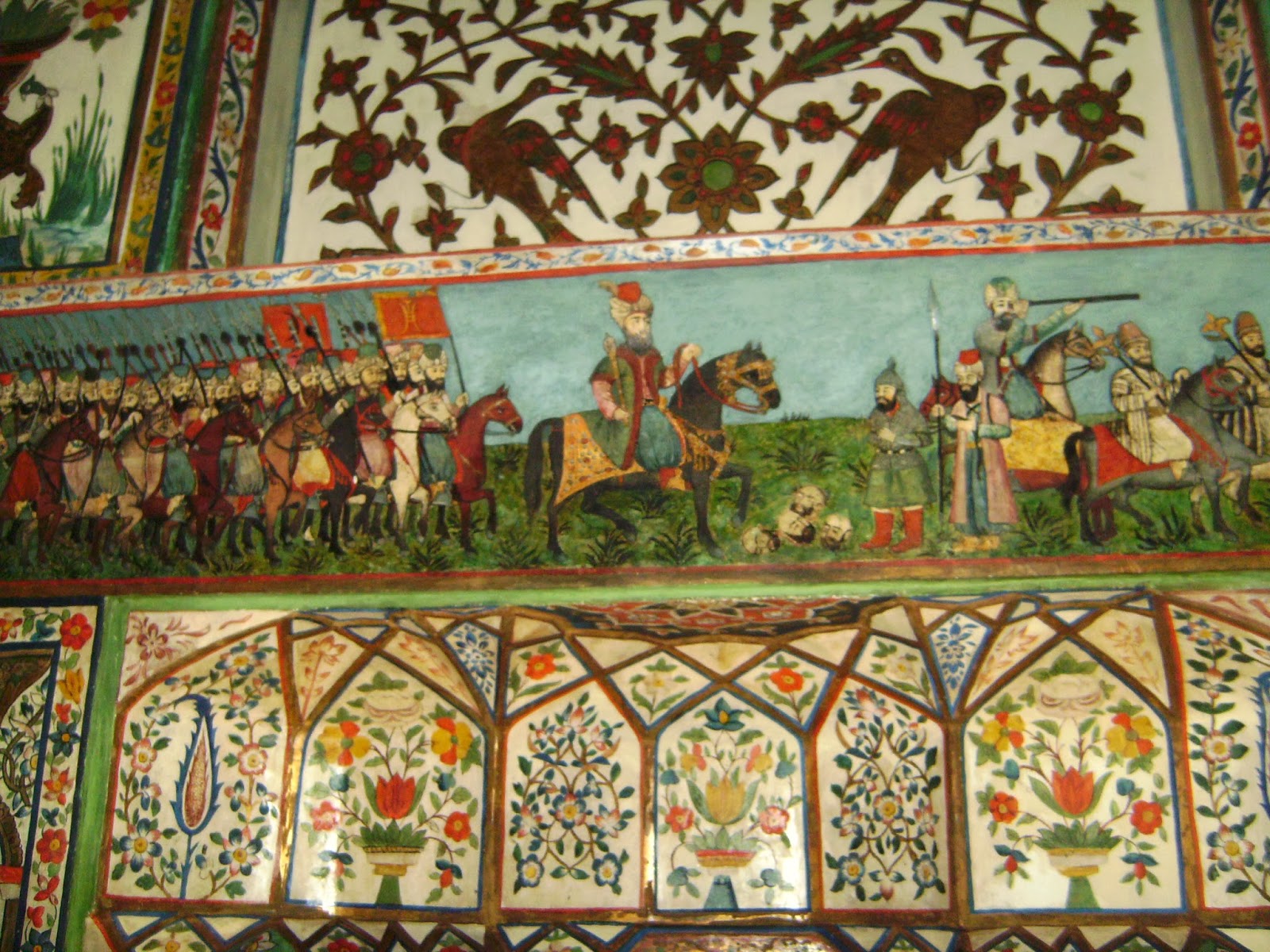
Within the walls of Sheki's Haci Chelabi Nukha's Fortress lies the magnificent and unique Khan's palace, which was finished in 1762 and is the only structure remaining from a much grander construction. Enormous plane trees (Chinar trees) said to date from 1530 and a charming rose garden sit in front, and the outside has a pretty turquoise, ochre and black patterned front. What makes it so lovely is the decorations by multiple 18th and 19th Century artists inside, which was recently extensively (re)restored. With mirrored stalactites (known as
muqarnas in Arabic), geometric patterns, painted scenes, and the regionally unique wood-framed, stained -glass geometric windows called
shabaka, it has more unique artistic elements that almost any building I've seen anywhere. The
shabaka themselves are jigsaw-intricate connections of tiny bits of wood and individual, loose, hand-cut pieces of glass. Each piece of glass is still held in place by carefully nailed bits of wood and it rattles in a strong wind (a workshop is near the entrance to the fortress).
It really is quite a tiny place with only one room's depth and only two floors high, but as every corner is covered it is gorgeous. While the apartment upstairs depicts the heroic battles of Haci Chelabi, including swords, guns, and severed heads, the lady's room next door has pastoral, flowery images while the lord's room has hunting, mythical beasts and lions eating antelopes!
Supposedly the balcony that emerges to the right of the building was the Khan's 'amnesty' window, from where he both sentenced and forgave criminals. The other balcony was for the Khan's wives!
Source: Loney Planet Georgia, Armenia and Azerbaijan 3rd Edition, 2008
Mark Elliot's Azerbaijan 4th Edition 2010


 The first time I went to Seville, it was a quick weekend trip from Morocco over Easter with several exchange friends from Al Akhawayn University. I don't think we slept for three days, doing the 8 hour drive to the coast in a shared taxi to catch the last ferry on Friday night. We cramped into a tiny hotel in Algeciras, while others roamed the streets all night. We took the first bus to Seville which was probably at least 5 hours, and arrived in the middle of the parades -- I was astounded to see that the Klu Klux Klan hoods had their origins in Catholic ritual and couldn't stop looking at the many white masks. I was entranced with my first experiences of tapas, sangria, all-night salsa bars, and the magic of Spain. I watched the sunrise after one particular night-spot, then began the long journey back in order to make it just in time for class on Monday morning! That time I was only in Seville very briefly, but I was destined to return for a work conference many years later. I only visited the cathedral very briefly on my first visit, following one parade float in and out the massive doors.


 The most memorable symbol of the cathedral, the tower called Giralda was actually built during Moorish Spain as the minaret of the Almohad Mosque (begun in 1184). Similar to the Mezquita (#946) in Cordoba, the mosque was converted into a church (and the Giralda a bell tower) after the Reconquista (1248). The Giralda was designed by the same architect (Jabir) as the Koutoubia mosque in Marrakech (#988) and the Hassan Mosque in Rabat (#864), although the top part of La Giralda dates from the Renaissance. I found it most impressive because it has no stairs to ascend to the top, only a ramp, and this ramp is high and wide and flat enough that a horse can be ridden all the way up!
  Officially called the Cathedral of Saint Mary of the See, it is the largest gothic church and the third largest church in the world. It surpassed the biggest at the time (the Hagia Sophia) when it was completed in the 16th century, having taken over a 100 years to build (1402-1506). It was damaged and/or destroyed by several earthquakes such as in 1356, 1376, 1511, and 1888.
 The nave is the longest in Spain and rises to a height of 42m. It has 80 chapels inside and 15 doors on its four sides: aside from the Main Door (the Door of Assumption), there are the Door of the Baptism, the Door of the Nativity (or Saint Michael), the Door de la Longa (or Saint Christopher), Door of the Conception, Door of the Lizard (a stuffed crocodile hangs from the ceiling!), Door of the Sanctuary, Door of Forgiveness, Door of the Sticks (or Adoration of the Magi), and the Door of the Bells.
  The burial place of Chistopher Columbus is just one symbol of its connection to the new world exploration: it was the trade wealth from the Americas that allowed such a large monstrosity to be built, and the gold that gilds its interior came from the new world. Along with the Alcazar and the General Archive of the Indies, it was declared a UNESCO World Heritage Site in 1987.