Wednesday, November 20, 2013

#750 Khan's Palace (Xan Sarayi), Sheki, Azerbaijan

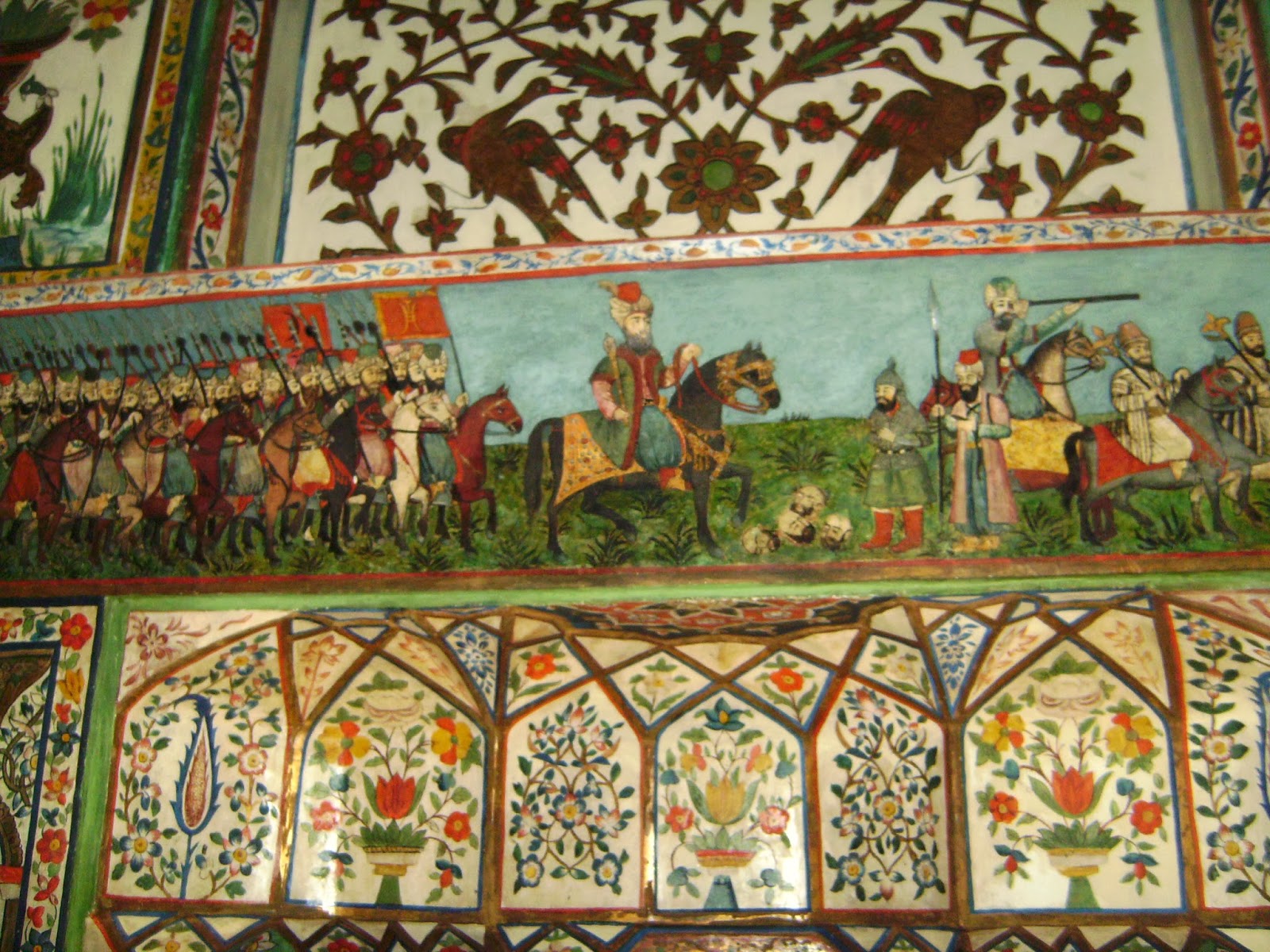
Within the walls of Sheki's Haci Chelabi Nukha's Fortress lies the magnificent and unique Khan's palace, which was finished in 1762 and is the only structure remaining from a much grander construction. Enormous plane trees (Chinar trees) said to date from 1530 and a charming rose garden sit in front, and the outside has a pretty turquoise, ochre and black patterned front. What makes it so lovely is the decorations by multiple 18th and 19th Century artists inside, which was recently extensively (re)restored. With mirrored stalactites (known as muqarnas in Arabic), geometric patterns, painted scenes, and the regionally unique wood-framed, stained -glass geometric windows called shabaka, it has more unique artistic elements that almost any building I've seen anywhere. The shabaka themselves are jigsaw-intricate connections of tiny bits of wood and individual, loose, hand-cut pieces of glass. Each piece of glass is still held in place by carefully nailed bits of wood and it rattles in a strong wind (a workshop is near the entrance to the fortress).
It really is quite a tiny place with only one room's depth and only two floors high, but as every corner is covered it is gorgeous. While the apartment upstairs depicts the heroic battles of Haci Chelabi, including swords, guns, and severed heads, the lady's room next door has pastoral, flowery images while the lord's room has hunting, mythical beasts and lions eating antelopes!
Supposedly the balcony that emerges to the right of the building was the Khan's 'amnesty' window, from where he both sentenced and forgave criminals. The other balcony was for the Khan's wives!
File:032palaceseki.jpg
http://en.wikipedia.org/wiki/File:032palaceseki.jpg
Source: Loney Planet Georgia, Armenia and Azerbaijan 3rd Edition, 2008
Mark Elliot's Azerbaijan 4th Edition 2010

Monday, November 18, 2013

#751 Padmanabhapuram Palace, (Kerala), Tamil Nadu, India

Far from the hippie beaches of Kovalam and actually technically into Tamil Nadu, but still part of Kerala lies the unpronounceable (like many Kerala names) Padmanabhapuram Palace.
Named as the finest surviving example of Keralan architecture due to its history as the seat of the rulers of the princely state of Travancore, it is a magnificent structure of carved teak and granite partially dating from 1550. Rosewood ceilings in floral designs, windows with jewel-colored mica, floors polished with a shell, coconut, egg-white, plant-juice compound, intricately Chinese-designed screens and pickle-jars, and beautiful people enjoying the coolness and peace.
Built in spurts with significant construction in 1601 and 1750, it was dedicated to King Marthaanda Varma's family deity Lord Padmanabha, a form of Lord Vishnu,so Padmanabhapuram translates to City of Lord Padmanabha. It lost importance when the capital was moved to Trhiruvananthapuram in 1795. Interesting parts of the palace include the King's Council Chamber (Mantrasala) which has beautiful windows decorated with mica, the Mother's Palace (Thai Kottaram) which is the oldest part of the palace and has an inner courtyard with downward-sloping roofs and the Nataksala performance hall. Most impressive, however is the four storey Upirrika Maliga with the king's bedrooms, the royal treasury, and in-wall storage for weapons as well as a worship chamber.
 
Amazing facts:
  • The clock in the clock tower is 300 years old but still keeps time.
  • The big hall can accommodate 1000 guests
  • The palace has a secret passage through which the king could escape to a safe place not far away
  • The Chinese jars (which fill an entire room) are said to be gifts from Chinese merchants that stayed
The courtyards and buildings are all unique in size, shape, purpose and decoration. The palace is beautiful and easy to wander about, with each corner yielding some other special surprise.
 
Lonely Planet India 11th Edition 2005


Saturday, November 16, 2013

#752 Inle Lake, Myanmar (Burma)

Where in the world do people still live on reed islands? Perhaps you've heard of Lake Titicaca in Peru, but much of that is for tourists now. In Myanmar, the large Inle Lake remains a truly island civilization, without the tourists to support it, although many tourists do visit now.

The Lake is not deep (averaging between 7 and 12 feet depending on the season), so  many of the floating islands are connected to the lake floor. In some areas poles able to push the small boats along, but in the middle of the lake the fishermen still use long paddles which they push with their feet curled around them standing up, so to be better able to see the fish, kyun myaw (floating islands), and beda (water hyacinth) and use the large cone-shaped nets to harvest carp (nga-hpein). Many towns are scattered along the shores, if you could really say that it has a clear shoreline, but the 17 village islands on stilts in the middle are vital for cultivation, trade and living.

The weekly market rotates through the various villages and is like something from the Middle Ages that emerges from the cool mists to reveal bullocks for sale along with roots, rice, vegetables, grains and of course the ubiquitous souvenirs. The 70,000 mostly Intha people of the area (although Shan, Pa-O/Taungthu, Taung-yo, Danu, Kayah, Danaw, and Bamar people are also present) continue to live as they have for centuries, following Buddhist traditions like visiting the 100 or so kyaung and 1000 stupas dotted around the area, with strongly Shan-influenced architecture and hardworking fishermen and agricultural lifestyles. The floating islands, with their marsh, hyacinth, soil masses, are incredibly fertile and kept stable by being staked to the bottom with bamboo poles. Other production includes silk weaving for garments, silver and lacquerware, and weaving of Shan-style shoulder bags.

Mystical, magical, otherworldly, and simple, it is an incredible place to visit! From the main township of Nyaungshwe at the northern end, to the typically Shan villages in the south, each little village offers something unique from a Jumping Cat Monastery (#945) at Nga Hpe Chaung, to a paper making factory, the Floating Market at Ywama, Lotus Weavers at Kyauk Taung, and hot springs at Kaung Daing. The Indein stupa and monastery to the south-west is also superb.

Around 22km long and 11km wide, it's altitude at 875m above sea level gives it an excellent climate. It has 20 species of snails and 9 species of fish unique in the world, but is suffering from environmental threats from increasing agriculture and tourism.

Source: Lonely Planet Myanmar 9th Edition 2005
http://en.wikipedia.org/wiki/Inle_Lake